Executive Summary
- Who this is for: Enterprise Architects, CTOs, CIOs, Architecture Leads, Engineering Directors
- Problem it solves: Technology decisions stall, duplicate, or collide because authority is assumed rather than assigned
- Key outcome: A structured model that maps decision rights by domain and altitude across the technology estate
- Time to implement: 30–60 days to build a working decision rights architecture for your organization
- Business impact: Faster delivery decisions, fewer escalation bottlenecks, reduced architecture conflict, and governance that works before something breaks
The Shipmaster and the Harbourmaster
A container ship arrives at port.
The captain has commanded that vessel for weeks.
They have made every decision.
Route. Speed. Crew assignments. Emergency protocols.
Their authority at sea is absolute.
Then the ship enters the harbour.
And a different authority takes over.
The harbourmaster controls berth allocation.
Entry timing.
Channel sequencing.
The weight and width limits for each dock.
The captain cannot override this.
They do not ask to.
Because the boundary is known.
The captain owns every decision about how the ship operates.
The harbourmaster owns every decision about where and when the ship moves within the port.
Neither tries to do the other's job.
Not because of hierarchy.
Because the decision rights are clear.
Now imagine a second scenario.
Same ship. Same port.
But no clear handoff exists.
The captain believes they own the berthing decision — they have been making navigation calls all week.
The harbourmaster believes they can direct the ship's internal readiness — the berth is ready and the ship must comply.
Nobody formally disagrees.
But nobody formally agrees either.
The ship sits at the channel entrance.
Waiting.
Not for a decision.
For someone to decide who gets to decide.
This is the exact state most enterprises are in with technology decisions.
The Escalation Ladder Is Not a Decision Rights Model
Most organizations have a process for technology decisions.
It usually looks like this:
A team cannot agree.
They escalate to the architecture board.
The architecture board cannot agree.
They escalate to the CTO.
The CTO makes a call.
Everyone returns to work.
This is an escalation ladder.
It is not a decision rights model.
The escalation ladder answers one question: who breaks the tie when things get stuck?
A decision rights model answers a different question: who should have decided this in the first place, and why was it escalated at all?
Most organizations have invested heavily in the first.
Almost none have built the second.
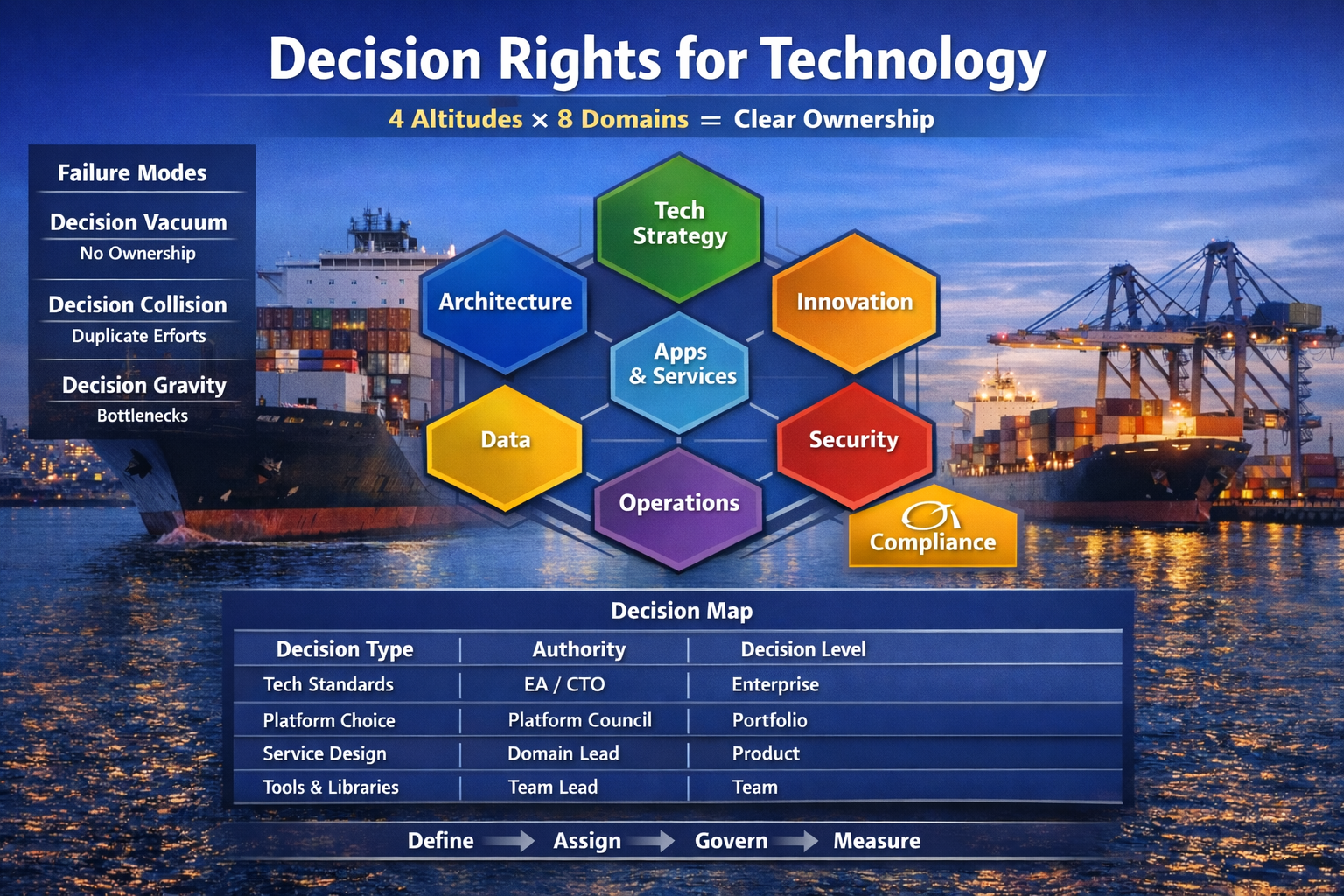
The Three Failure Modes
When decision rights are unclear, three failure patterns appear consistently.
Nobody is certain who holds authority for a class of decision.
So nobody decides.
Teams wait.
Delivery stalls.
The work technically belongs to someone — but nobody wants to claim a decision they might later be accountable for.
The vacuum looks like a process problem.
It is an authority problem.
Failure Mode 2: Decision Collision
Two parties make the same decision independently.
Neither knew the other was deciding.
A domain team selects a messaging platform.
An enterprise architecture team has already standardized on a different one.
Both decisions were made in good faith.
Neither party had clear authority to make the call without informing the other.
The collision surfaces weeks later.
By which time one decision has been implemented.
The cost of unwinding it is no longer a governance conversation.
It is a delivery crisis.
Failure Mode 3: Decision Gravity
All decisions pull upward.
Regardless of their actual altitude.
Library choice. Cloud provider. Platform build versus buy. API naming conventions.
All of them travel up the same chain.
The architecture board reviews things it should never see.
The CTO is asked to decide things a team lead should own.
Leadership becomes a bottleneck.
Not because they are unwilling to delegate.
Because nobody has defined what delegation actually means.
Decision gravity looks like slow governance.
It is an undefined rights structure.
Technology Decision Domain Architecture (TDDA)
The solution is not a better escalation process.
The solution is a structured model that assigns decision rights before conflict requires them.
This model is called Technology Decision Domain Architecture (TDDA).
TDDA maps every class of technology decision to a defined altitude and domain.
It answers two questions simultaneously.
At what altitude should this decision be made?
Within which domain does this decision belong?
Once both are answered, the right decision authority is clear.
The Two Axes
TDDA operates across two axes.
Axis 1: Decision Altitude
Technology decisions exist at four altitudes.
| Altitude | Description | Examples |
|---|---|---|
| Enterprise | Decisions that set constraints for the entire organization | Architecture principles, approved cloud providers, mandatory security standards |
| Domain | Decisions that govern a bounded business or technology domain | Domain platform choices, data ownership rules, integration contracts |
| Team | Decisions within a team's implementation boundary | Library selection within approved standards, internal service structure |
| Individual | Decisions a practitioner makes in the act of delivery | Variable naming, local refactoring, in-sprint implementation approach |
The altitude tells you how wide the consequence of this decision reaches.
Enterprise-altitude decisions affect everyone.
Individual-altitude decisions affect almost no one beyond the person making them.
Most escalation failures happen because a team-altitude decision gets treated as enterprise-altitude — or an enterprise-altitude decision gets made without any governance at all.
Axis 2: Decision Domain
Technology decisions also belong to a specific domain of concern.
| Domain | Covers | Typical Owner |
|---|---|---|
| Investment | Build vs. buy, vendor selection, budget allocation | Architecture board + CTO |
| Standards | Approved technologies, languages, protocols | Enterprise Architecture |
| Platform | Core infrastructure and shared service decisions | Platform Engineering + EA |
| Integration | APIs, events, contracts between systems | Domain Architecture |
| Implementation | How a team delivers within its boundary | Engineering Team |
| Security | Access, data classification, threat surface | Security Architecture |
A decision belongs to a specific altitude AND a specific domain.
Together, these two axes define the precise location of decision authority.
The TDDA Decision Map
Combining both axes produces a decision map.
| Investment | Standards | Platform | Integration | Implementation | Security | |
|---|---|---|---|---|---|---|
| Enterprise | CTO + Arch Board | Enterprise Arch | CTO + Platform Lead | Enterprise Arch | — | CISO |
| Domain | Domain Lead + Arch | Domain Arch | Platform Eng | Domain Arch | — | Security Arch |
| Team | — | Eng Lead (within standards) | — | Team Arch | Eng Lead | Security review |
| Individual | — | — | — | — | Engineer | — |
Every blank cell is intentional.
Not every altitude applies to every domain.
An individual engineer does not make investment decisions.
An enterprise architecture team does not decide variable naming conventions.
The map makes the authority visible.
And it makes the blanks visible too.
A blank where a cell should not be blank is a decision rights gap waiting to become a delivery failure.
Identifying Decision Rights Gaps
Once the map exists, three gap types become visible.
Gap 1: Altitude Mismatch
A decision is being made at the wrong altitude.
A team is making a vendor selection that should sit at enterprise altitude.
Or an architecture board is reviewing implementation approaches that belong at team altitude.
Altitude mismatch generates either ungoverned decisions or governance bottlenecks.
Both are expensive.
Gap 2: Domain Vacancy
A decision domain has no assigned owner at any altitude.
Integration contract standards.
Data classification at domain level.
Security review ownership for new services.
These vacancies do not stay quiet.
They generate conflict at the moment a decision becomes necessary.
Gap 3: Authority Overlap
Two owners share authority over the same cell in the map.
Both believe they have the right to decide.
Neither is wrong — the map was never drawn.
Authority overlap produces Decision Collisions.
The TDDA map makes overlaps visible before they produce incidents.
What Breaks When This Is Ignored
When decision rights are undefined:
Delivery stalls on decisions that should never have escalated.
A team needs to choose between two logging frameworks. Both are acceptable. Neither is on an approved list. The decision goes to the architecture board. The architecture board has twelve items on its agenda. The team waits three weeks. The sprint is blocked. The reason recorded in the retrospective is "architecture process." The real reason is that nobody defined who owns this decision class.
Parallel solutions appear without coordination.
Two domains independently select different API gateway vendors. Both decisions were technically correct. Neither team had a mandate to inform the other. Six months later, enterprise architecture discovers two incompatible standards in production. The rationalization programme takes two years and costs more than either original selection.
Governance looks broken even when it is working.
Leadership is asked to decide too many things. They are not bad at governance. They are absorbing decisions that should never have reached them. The decision gravity makes governance feel slow. The real problem is that nobody has defined what should stay at team altitude.
When TDDA is in place:
The architecture board reviews enterprise-altitude decisions.
Not everything.
Domain teams make domain-altitude decisions confidently — without waiting for approval they were never supposed to need.
Delivery moves at the speed decisions actually require.
Governance stops being a bottleneck.
It becomes a guardrail.
Implementation Guide (30–60 Days)
Building a decision rights architecture requires honesty more than technology.
The hardest part is naming who does not hold authority.
Phase 1: Map the Current State (Weeks 1–2)
Identify the ten most common technology decision classes in your organization.
For each:
- What altitude does it currently reach before resolution?
- Who believes they hold authority to decide?
- How long does it typically take to resolve?
Do not design anything yet.
Document what actually happens.
Deliverable: Current-state decision inventory — ten decision classes with altitude, owner claim, and resolution time
Success Metric: At least three decision classes where two different parties claim ownership — these are the Decision Collisions waiting to happen
Phase 2: Build the TDDA Map (Weeks 3–4)
Using the two axes, map each decision class to its correct altitude and domain.
For every cell in the map:
- Assign a named owner or authority body
- Mark cells that should be blank as intentionally vacant
- Highlight cells where current practice mismatches the correct altitude
Document every mismatch as a Decision Rights Gap.
Deliverable: First version of the TDDA map with gaps identified
Success Metric: At least one altitude mismatch, one domain vacancy, and one authority overlap identified and documented
Phase 3: Operationalize the Model (Weeks 5–8)
Introduce the TDDA map as a standard governance artifact.
Add a decision rights check to every architecture review.
For each initiative: identify every decision class it will require, and confirm the authority owner before work begins.
Update the map quarterly.
Decision classes change as the organization changes.
The map must evolve with it.
Deliverable: TDDA map embedded in architecture governance cycle
Success Metric: At least two delivery decisions resolved without escalation because the authority was clear — and at least one escalation that should not have occurred, now prevented by the map
Evidence from Practice
Organizations that build a TDDA map for the first time consistently find the same patterns.
The altitude mismatch count is higher than anyone expected.
Teams are making vendor decisions that should sit at enterprise altitude.
Architecture boards are reviewing implementation details that belong at team altitude.
Both believe they are doing the right thing.
Neither knows the other is compensating for the same undefined rights structure.
The domain vacancy findings produce a different discomfort.
Nobody owns integration contract standards at domain level.
Nobody owns data classification authority below enterprise level.
The vacancies were not designed.
They were inherited.
Nobody drew a map when the domains were defined, so the gaps were never visible.
The authority overlaps produce the most important conversations.
Two functions have been resolving the same class of decision independently for months.
Sometimes they reach the same answer.
Sometimes they do not.
Nobody knew both were deciding.
The TDDA map names the overlap.
Named gaps get resolved.
Unnamed gaps become production incidents.
Action Plan
This Week
Ask three questions:
- Can you name the owner of every technology decision your most important initiative will require — before the initiative starts?
- In your last architecture conflict, was the disagreement about the decision itself — or about who had the right to make it?
- How many decisions reached your architecture board last quarter that should never have left team altitude?
If these answers are unclear, your organization has an escalation ladder.
Not a decision rights architecture.
Next 30 Days
Select one delivery domain.
List the ten decision classes it encounters most frequently.
Map each to the correct altitude and domain using the TDDA model.
Identify every gap.
Document every overlap.
That map is your decision rights starting point.
3–6 Months
Extend TDDA across all delivery domains.
Embed a decision rights check into every new project initiation.
Every initiative should begin with a clear map of what decisions it will require — and who holds authority to make each one.
Governance becomes predictable when authority is legible.
Not when conflict forces it into the open.
Final Thought
The ship waited at the channel entrance.
Not because nobody had authority.
Because both parties had assumed they did.
The harbourmaster owned that boundary.
The captain knew it.
The ship moved.
Technology decisions do not stall because organizations lack governance.
They stall because nobody drew the map that tells authority where it ends.
Turn Your Escalation Ladder Into a Decision Rights Architecture
If your architecture board is reviewing decisions it should never see…
if delivery teams are waiting for approvals they were never supposed to need…
or if the same authority conflicts keep appearing in different projects under different names —
your organization may have an escalation process where a decision rights architecture should be.
In a focused 30-minute Technology Decision Rights Diagnostic, we will:
- Map the decision classes your organization encounters most frequently
- Identify altitude mismatches, domain vacancies, and authority overlaps in your current practice
- Introduce the TDDA model for your technology governance environment
- Define a 30-day plan to build a working decision rights map for your highest-priority domain
No governance theater.
No escalation redesigns that add committees instead of clarity.
No authority conversations postponed until delivery forces them.
Just a map that tells everyone where their authority ends — before the conflict begins.
→ Book an Architecture Strategy Session
or
The ship knew its captain.
The harbour knew its master.
The boundary was the governance.